
01
Survival
From the ruins of the future
As a boy playing at the former Expo ’70 site in Osaka, he saw a future being dismantled. In the 1990s, he began making actual machines for survival.
Source Material ↗
01 / 36The World of the Works
GINZA SIX, TOKYO · 2024–2025
From imagined futures to real spaces.
Selected Awards / 1993—2022
Past honors including the Osaka Culture Prize and Kyoto Prefecture Culture Prize
Awards and Honors
Recognizing his work in contemporary art.
An honor for cultural achievement from Kyoto Prefecture. Presented in 2013.
An award from Osaka City for cultural activities.
An honor awarded to the artist.
Awarded in the fine arts category.
The 21st award, presented to the artist.
An honor recognizing the artist’s work.
The 21st Contemporary Japanese Sculpture Exhibition, Ube Industries, Ltd. Award. An award for the work.
The 21st exhibition featuring Villa TORAYAN was held in 2005. The artist’s official biography lists the award year as 2006, so the exhibition year is used here.
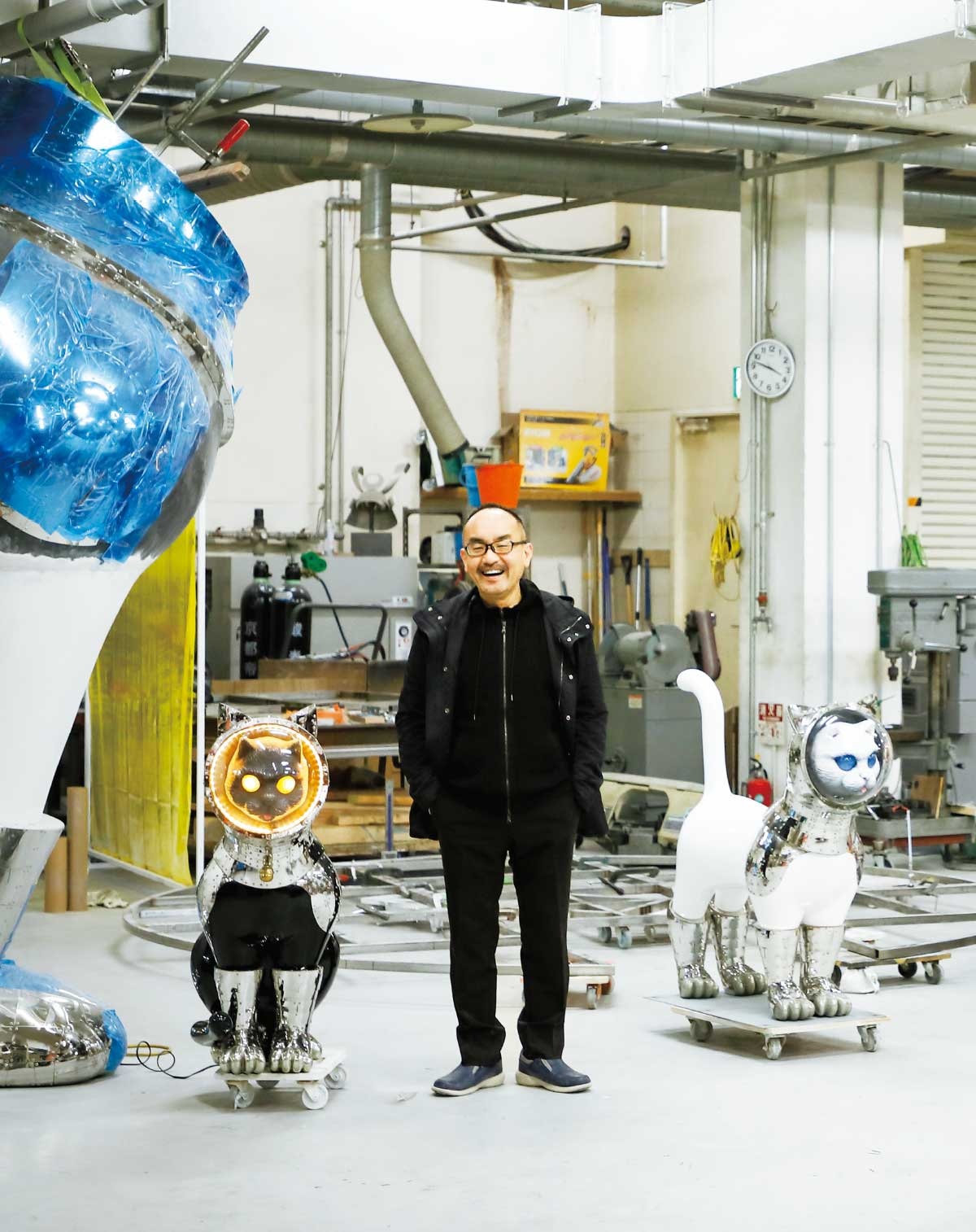
Kenji YanobeContemporary Artist / Active Since 1990
02 / 36About the Artist
Kenji Yanobe · Contemporary Artist
Contemporary artist Kenji Yanobe began his practice in 1990 with the mechanical sculpture Tanking Machine. From a child figure embodying a wish for renewal to a cat traveling through the city, he creates worlds that visitors can enter, crossing sculpture, characters, architecture, and public space.
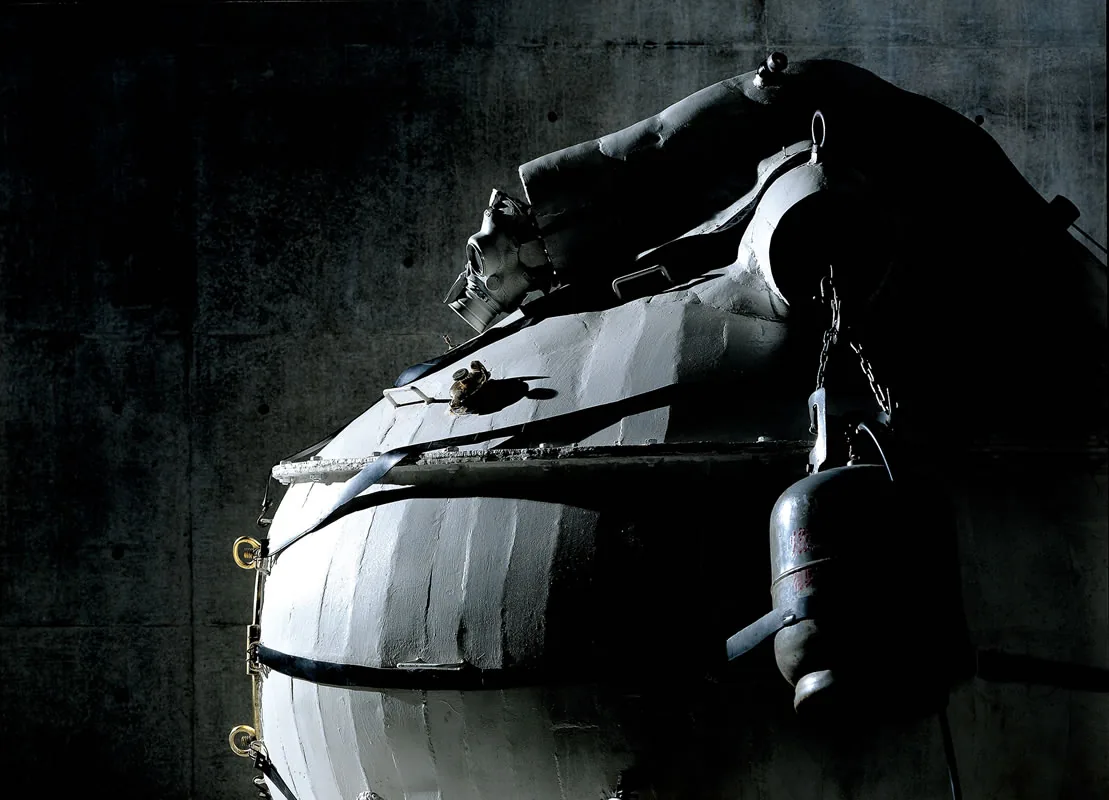
1990 / Award-Winning Work
Tanking Machine
A mechanical sculpture that creates the experience of floating in saline solution. It won the Grand Prize at the first Kirin Contemporary Art Award and is now in the collection of the 21st Century Museum of Contemporary Art, Kanazawa.
International Activity
From survival devices to guardian cats, the works have taken different forms in museums, exhibitions, and cities around the world.


A record of exhibitions, installations, and collections across cities, organized by type.
BORDEAUX / FRANCE
Exhibition
Traffic
Participated in an international group exhibition at CAPC Musée d’art contemporain.
SAN FRANCISCO / USA
Solo Exhibition
Survival System Train and Other Sculpture
A solo exhibition at the Center for the Arts in Yerba Buena Gardens brought the era of survival devices to an international audience.
NEW YORK / USA
Exhibition
Little Boy
Participated in an exhibition organized by Japan Society, introducing Japanese postwar art and subculture.
NEW YORK / USA
Exhibition
Heavy Light
Participated in an exhibition at the International Center of Photography introducing Japanese photography and moving-image practices.
KYIV / UKRAINE
International Exhibition
ARSENALE 2012
Participated in the first Kyiv Biennial of Contemporary Art.
METZ / FRANCE
Exhibition
Japanorama
Atom Suit Project – Desert was presented in an exhibition at Centre Pompidou-Metz.
PARIS / FRANCE
Exhibition
SHIP’S CAT
An exhibition at the Carrousel du Louvre presented SHIP’S CAT and a work created with Eriko Horiki.
SHANGHAI / CHINA
Public Installation
SHIP’S CAT (Sailor)
Installed a guardian cat in a public space in Shanghai.
PARIS / FRANCE
Museum Collection
Collection: Emergency Escape Pod – E. E. Pod 1
Emergency Escape Pod – E. E. Pod 1 entered the museum’s collection. Collection record.
HONG KONG / CHINA
Museum Collection
Collection: Torayan Head Train
M+ holds Torayan Head Train in its collection.
GWANGJU / KOREA
Exhibition
BANDI WALK
Participated in a media façade project at Asia Culture Center.
PINGTUNG / TAIWAN
Solo Exhibition
SHIP’S CAT in Pingtung
His first solo exhibition in Taiwan, at Seaside Museum, presented several forms of SHIP’S CAT.
AUXERRE / FRANCE
Exhibition
Quête d’infinis
The collection work Emergency Escape Pod – E. E. Pod 1 was shown in an exhibition co-organized with Centre Pompidou.
SINGAPORE
Exhibition
ART BIT MATRIX
An exhibition at Mizuma Gallery presented a collaborative work connecting sculpture and games.
Selected international exhibitions, installations, and collections are presented here. Cities with photographs link to the images; the others link to records.
 QUEEN MAMMA / 2002
Selected Collaborations
Past collaborators
Origins and Evolution of the Works
The landscape he saw at the dismantled site of Expo ’70 in Osaka became the starting point for his work. That question has changed form with the times and the places it encounters.
From the ruins of the future
As a boy playing at the former Expo ’70 site in Osaka, he saw a future being dismantled. In the 1990s, he began making actual machines for survival.
Source Material ↗
Confronting real wounds
In 1997, he visited Chernobyl wearing a suit that detects radiation. In time, the question shifted from survival toward revival and hope.
Source Material ↗
Opening stories to the city
A guardian cat, monumental sculptures, an island floating on a lake. The artist’s imagination takes form in places and experiences that anyone can encounter.
Source Material ↗The World of Kenji Yanobe’s Works
Looking back across decades of work
Trace More Than 35 Years of Change ↘
03 / 36The World of the Works
SHIP’S CAT (MUSE) · OSAKA
Work / Year CreatedSHIP’S CAT (Muse) · 2021
LocationKita Ward, Osaka / Nakanoshima Museum of Art, Osaka
StoryMade to watch over the museum that opened in 2022 and the people passing through its interior passage.
Artistic IntentA guardian cat that became a symbol of the museum by the Dojima River and watches over its connection to the world.
Source Material ↗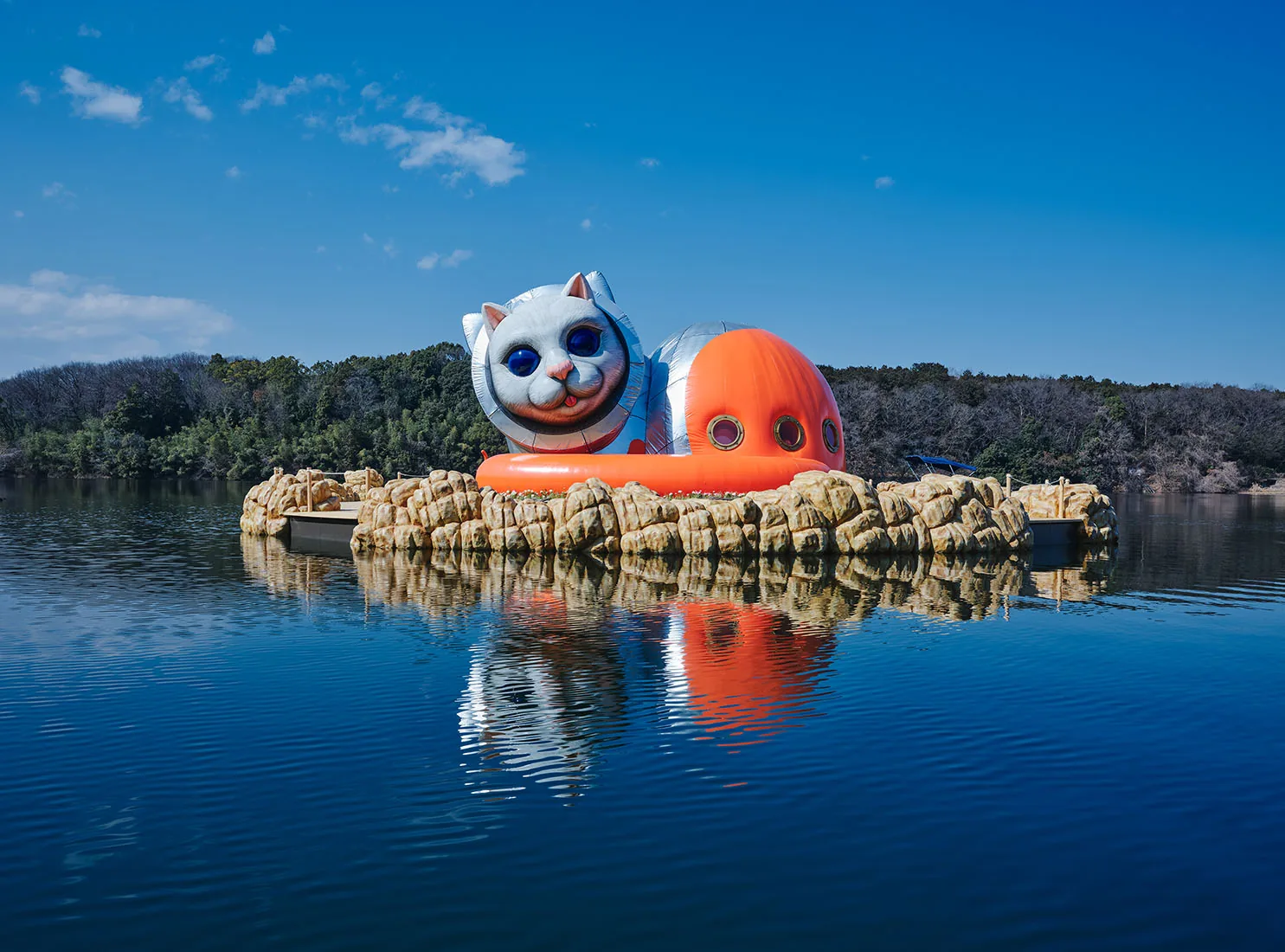
04 / 36The World of the Works
SHIP’S CAT ISLAND · HANNO · 2025
Work / Year CreatedSHIP’S CAT ISLAND · 2025
LocationHanno, Saitama / Metsa, Lake Miyazawa
StoryPresented as a work floating on Lake Miyazawa at the opening exhibition of Hyper Museum Hanno.
Artistic IntentConceived as an island where a space cat rests. Visitors could approach by boat and land on the work during the exhibition.
Source Material ↗05 / 36The World of the Works
How do we survive?
Wearing a suit that detects radiation, Yanobe traveled to Chernobyl. The “ruins of the future” he had imagined overlapped with reality.
06 / 36The Origin of His Practice
Expo '70 site · Osaka
As a child, he played at the dismantled site of Expo ’70 in Osaka. He calls the sight of buildings that once promised the future becoming ruins the “ruins of the future.” That memory became the origin of his practice.

07 / 36The Origin of His Practice
TANKING MACHINE · 1990
Work / Year CreatedTanking Machine · 1990
LocationKyoto / Art Space NIJI (First Solo Exhibition)
StoryA mechanical sculpture presented at his first solo exhibition. Rather than only viewing it, visitors could experience the work from inside.
Artistic IntentEntering a tank filled with saline solution close to body temperature, visitors floated as their senses changed. The work made survival apparatus something to experience physically.
Source Material ↗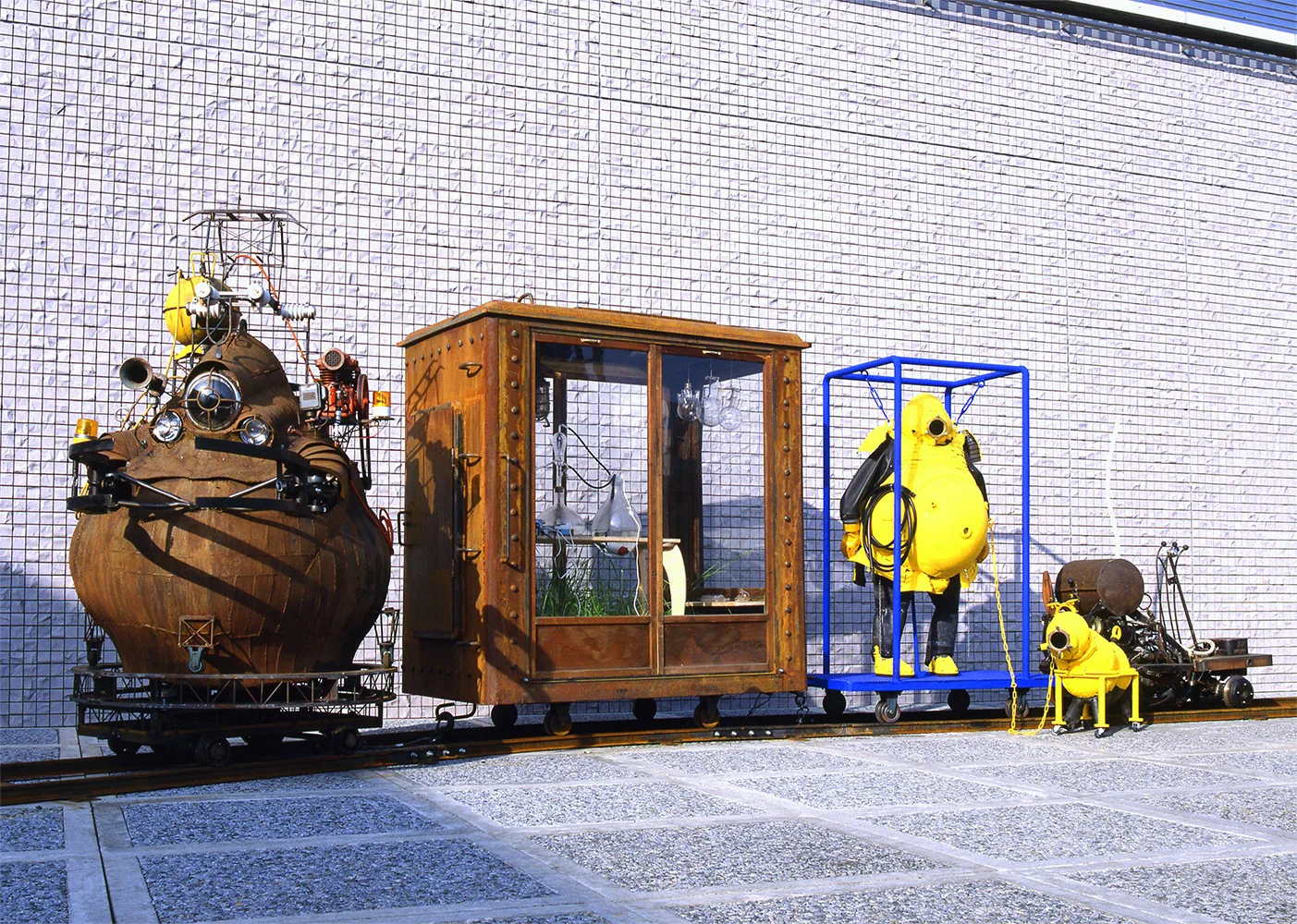
08 / 36The Origin of His Practice
SURVIVAL SYSTEM TRAIN · 1992–1997
Work / Year CreatedSurvival System Train · 1992–1997
CollectionCollection of Toyota Municipal Museum of Art
StoryConceived as a mobile survival device carrying oxygen, water, and everyday supplies.
Artistic IntentA private train carrying oxygen, water, and everyday supplies. The functions needed for survival took the form of a real machine.
Source Material ↗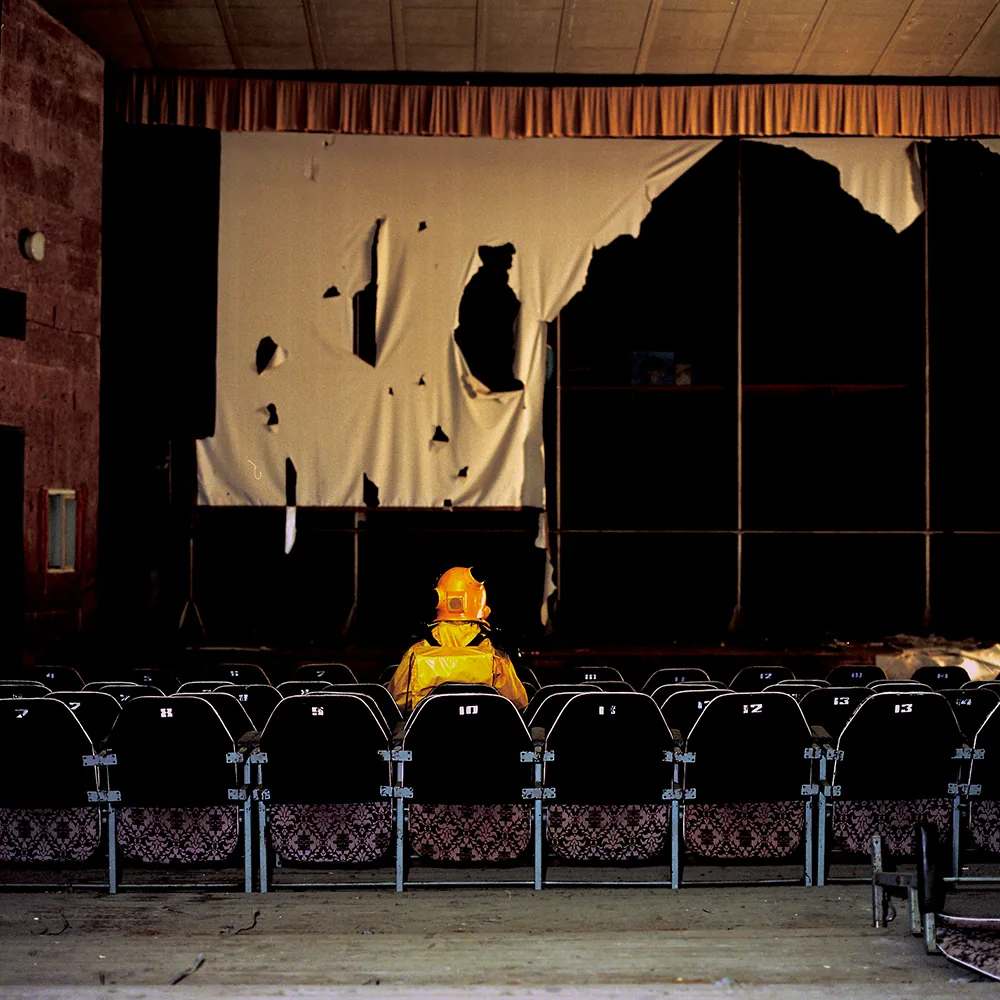
09 / 36The Origin of His Practice
ATOM SUIT PROJECT · CHERNOBYL · 1997
Work / Year CreatedAtom Suit Project · 1997
LocationUkraine / Former Cinema in Prypiat
StoryHe visited a city left uninhabited after the Chernobyl disaster, encountering the “ruins of the future” he had imagined in a real place.
Artistic IntentWearing a suit that detects radiation, he brought a collective anxiety into the senses of his own body.
Source Material ↗10 / 36The Origin of His Practice
What he saw in Chernobyl was not imaginary ruins, but the reality of the people living there. The question in his work shifted from “How do we survive?” to “How do we rise again?”
11 / 36The Origin of His Practice
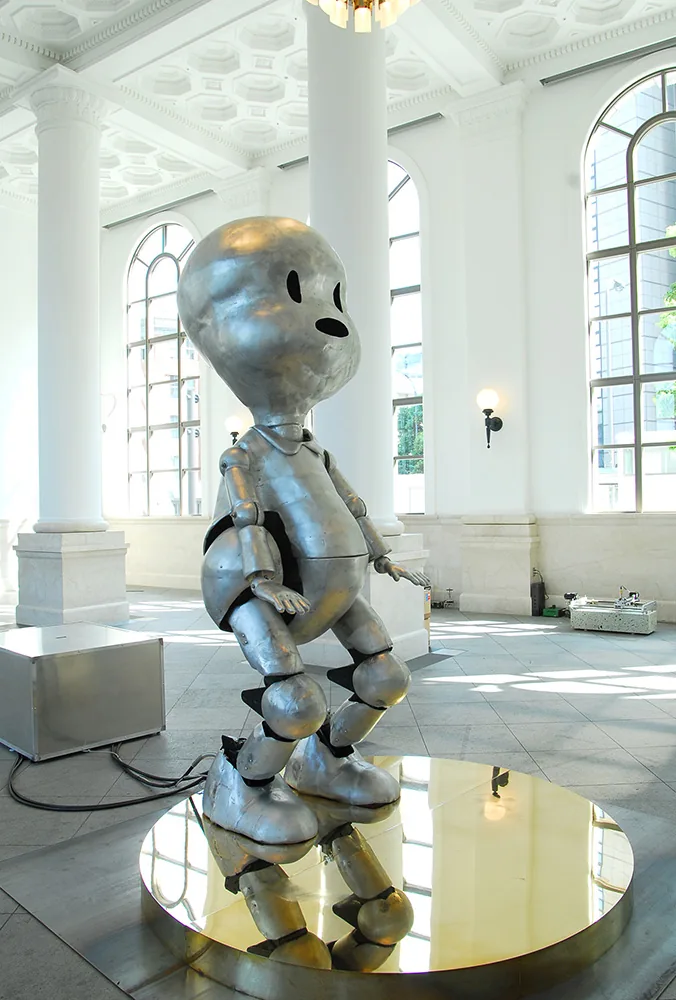
VIVA RIVA PROJECT: STANDA · 2001
Work / Year CreatedViva Riva Project: Standa · 2001
CollectionCollection of the 21st Century Museum of Contemporary Art, Kanazawa
StoryInspired by a doll and a sun painted on the wall of an abandoned nursery in Chernobyl.
Artistic IntentWhen it detects radiation, the doll stands up and the sun grows brighter. Mechanical movement becomes a gesture of renewal.
Source Material ↗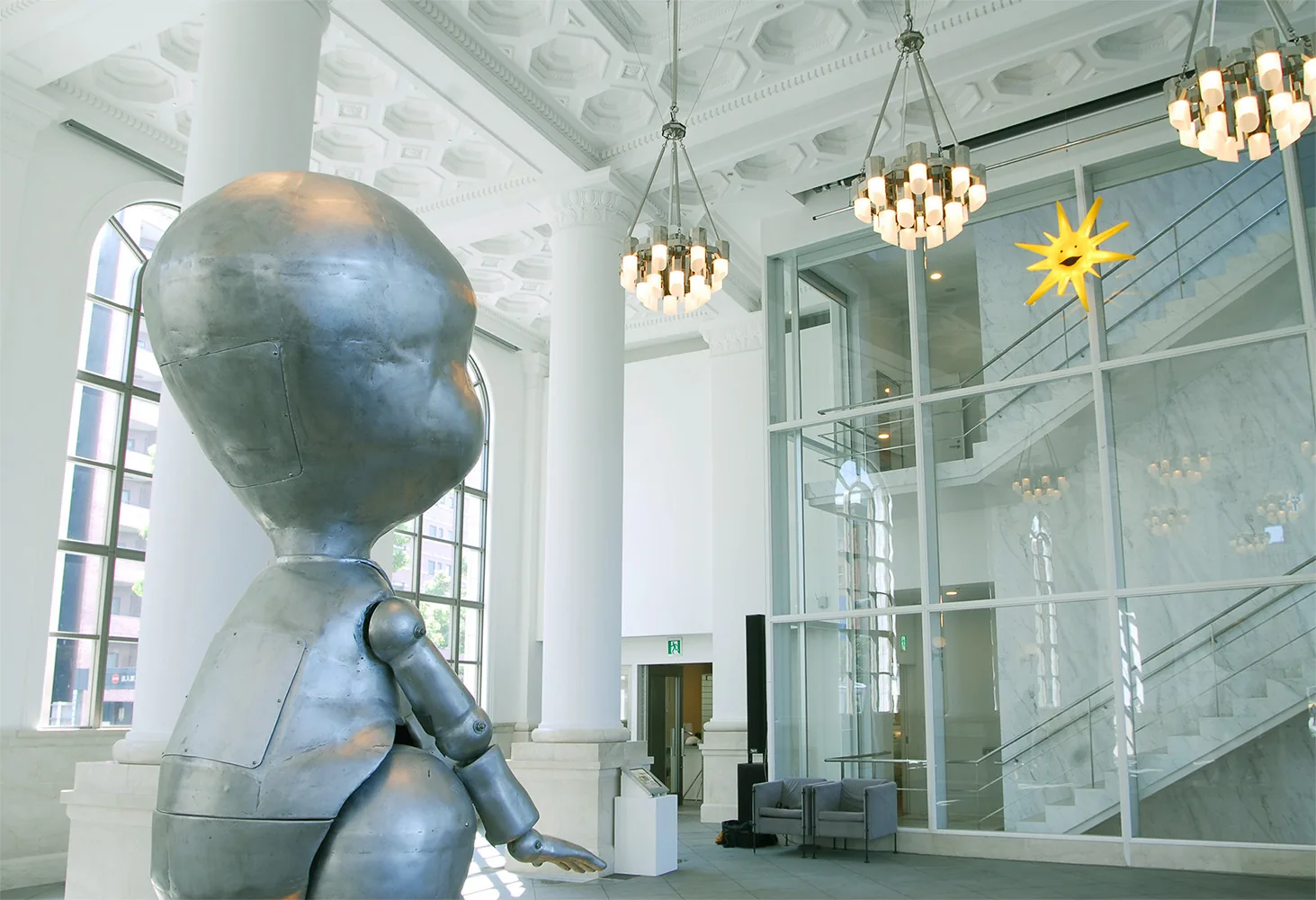
12 / 36The Origin of His Practice
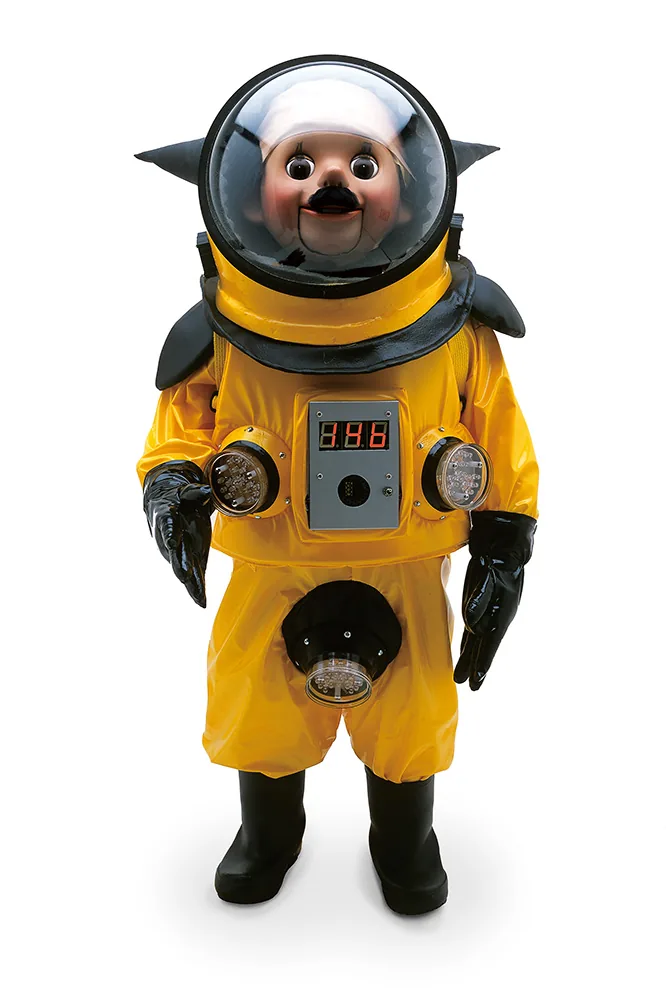
TORAYAN · 2004
Work / Year CreatedTorayan · 2004
StoryHis father’s ventriloquist doll, Torayan, entered the world of his work.
Artistic IntentA character crossing the boundary between children and adults grew monumental and carried the story into other works.
Source Material ↗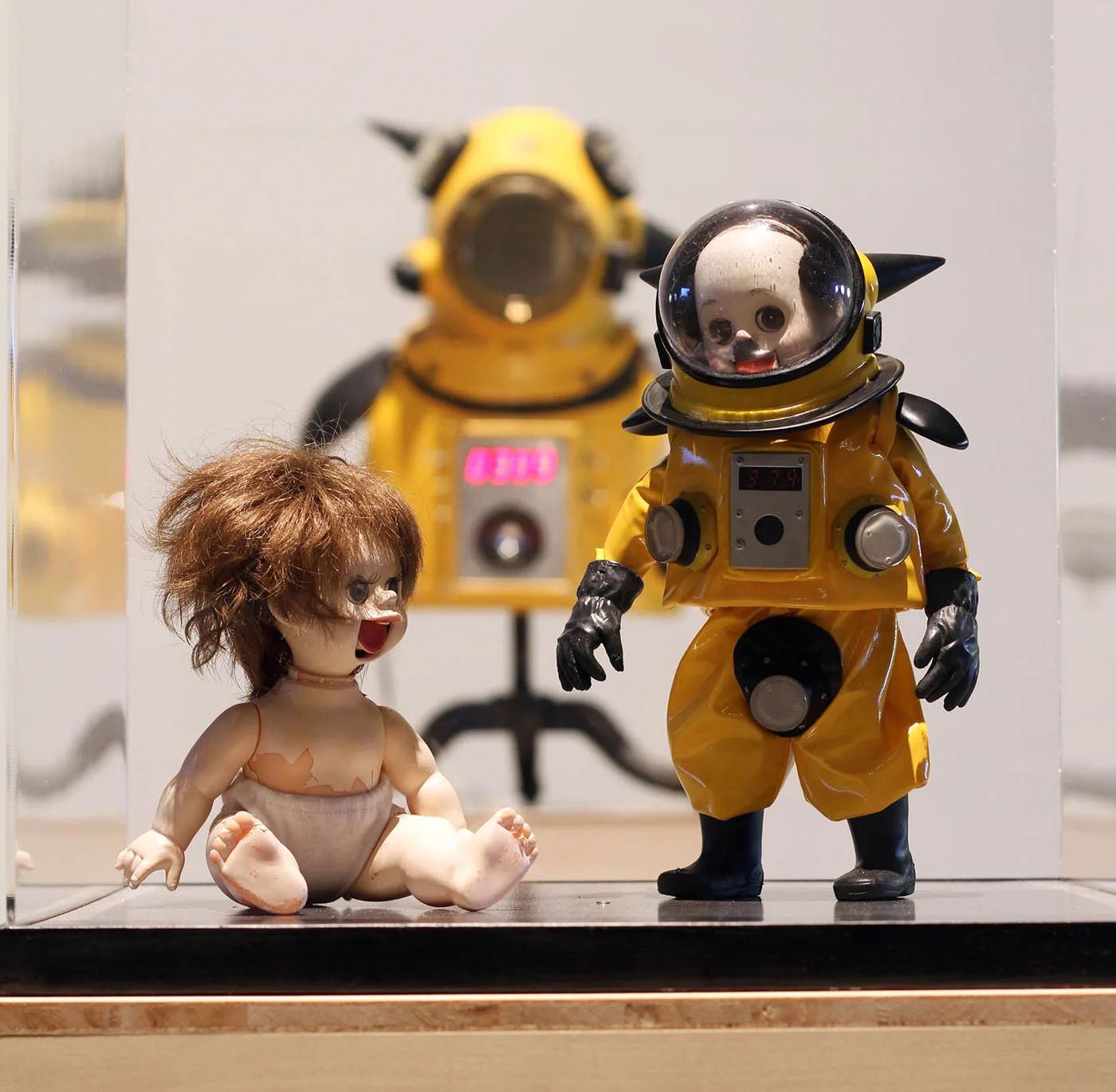
13 / 36The Origin of His Practice
Survive · Witness · Awaken · Guard · Voyage · Imagine
From sealed survival devices to a doll that stands up, a child of hope, a traveling cat, and a story of the cosmos: more than 35 years of work connect as the changing forms of a single question.

14 / 36Sculptures of Hope
GIANT TORAYAN · 2005
Work / Year CreatedGiant Torayan · 2005
CollectionCollection of Nakanoshima Museum of Art, Osaka
StoryDeveloped from the ventriloquist doll Torayan into a 7.2-meter-tall mechanical sculpture.
Artistic IntentFollowing children’s commands, it sings, dances, and breathes fire. An imagined protector brought to life on a real-world scale.
Source Material ↗
15 / 36Sculptures of Hope
Work / Year CreatedGiant Torayan · 2005
CollectionCollection of Nakanoshima Museum of Art, Osaka
StoryThe character developed into a figure with movement and a voice.
Artistic IntentEquipped to sing, move, and breathe fire, the character acts in a real space.
Source Material ↗
16 / 36Sculptures of Hope
LUCKY DRAGON · AQUA METROPOLIS OSAKA · 2009
Work / Year CreatedLucky Dragon · 2009
LocationRivers of Osaka / Aqua Metropolis Osaka 2009
StoryA sightseeing boat was converted for an event themed around the revival of the waterfront. It actually cruised the rivers of Osaka.
Artistic IntentA “dragon that brings good fortune,” also carrying the memory of the Daigo Fukuryu Maru fishing boat. A symbol of crisis became a figure wishing for the city’s revival as a waterfront metropolis.
Source Material ↗17 / 36Sculptures of Hope
SUN CHILD · 2011–2012
Work / Year CreatedSun Child No.3 · 2012
LocationIbaraki, Osaka / Rotary in Front of Minami-Ibaraki Station
StoryInstalled as a monument in Yanobe’s hometown of Ibaraki after the Great East Japan Earthquake and nuclear accident.
Artistic IntentThe child removes its helmet and holds up a small sun; its radiation meter reads zero.
Source Material ↗
18 / 36Sculptures of Hope
SUN SISTER · KOBE · 2015
Work / Year CreatedSun Sister · 2015
LocationKobe / Hyogo Prefectural Museum of Art, Museum Road
StoryInstalled as a monument marking 20 years since the Great Hanshin-Awaji Earthquake.
Artistic IntentLike an elder sister to Sun Child, she holds the sun and watches over recovery and renewal after disaster.
Source Material ↗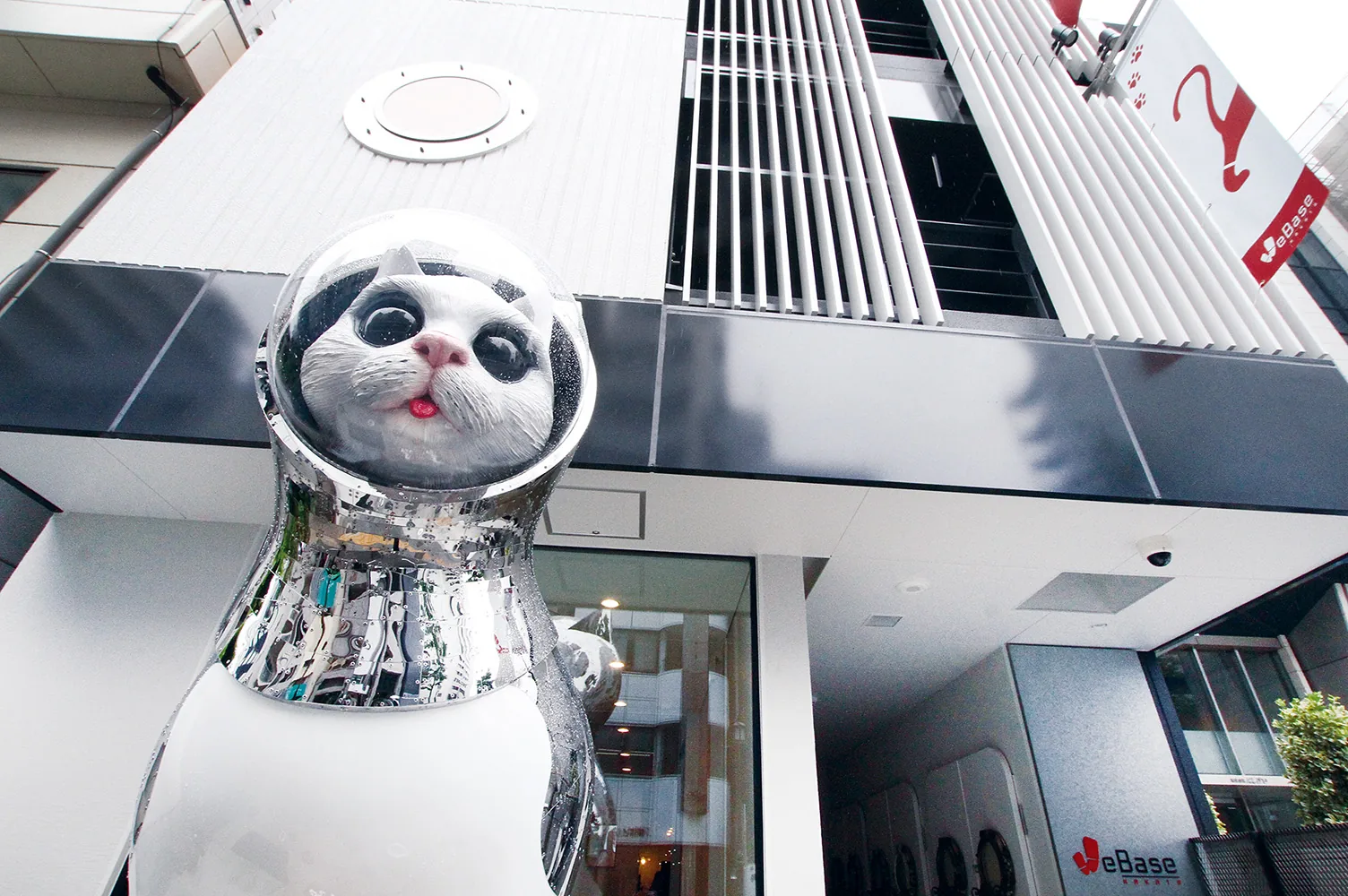
19 / 36The Journey of the Works
SHIP’S CAT · HAKATA · 2017
Work / Year CreatedSHIP’S CAT · 2017
LocationHakata Ward, Fukuoka / WeBase Hakata
StoryCreated as a guardian to guide travelers at a hostel in the port city of Hakata, connecting the inside and outside of the building.
Artistic IntentInspired by cats that protected people and cargo on sea voyages, it embodies encounters, safety, and hope for the next journey.
Source Material ↗20 / 36The Journey of the Works
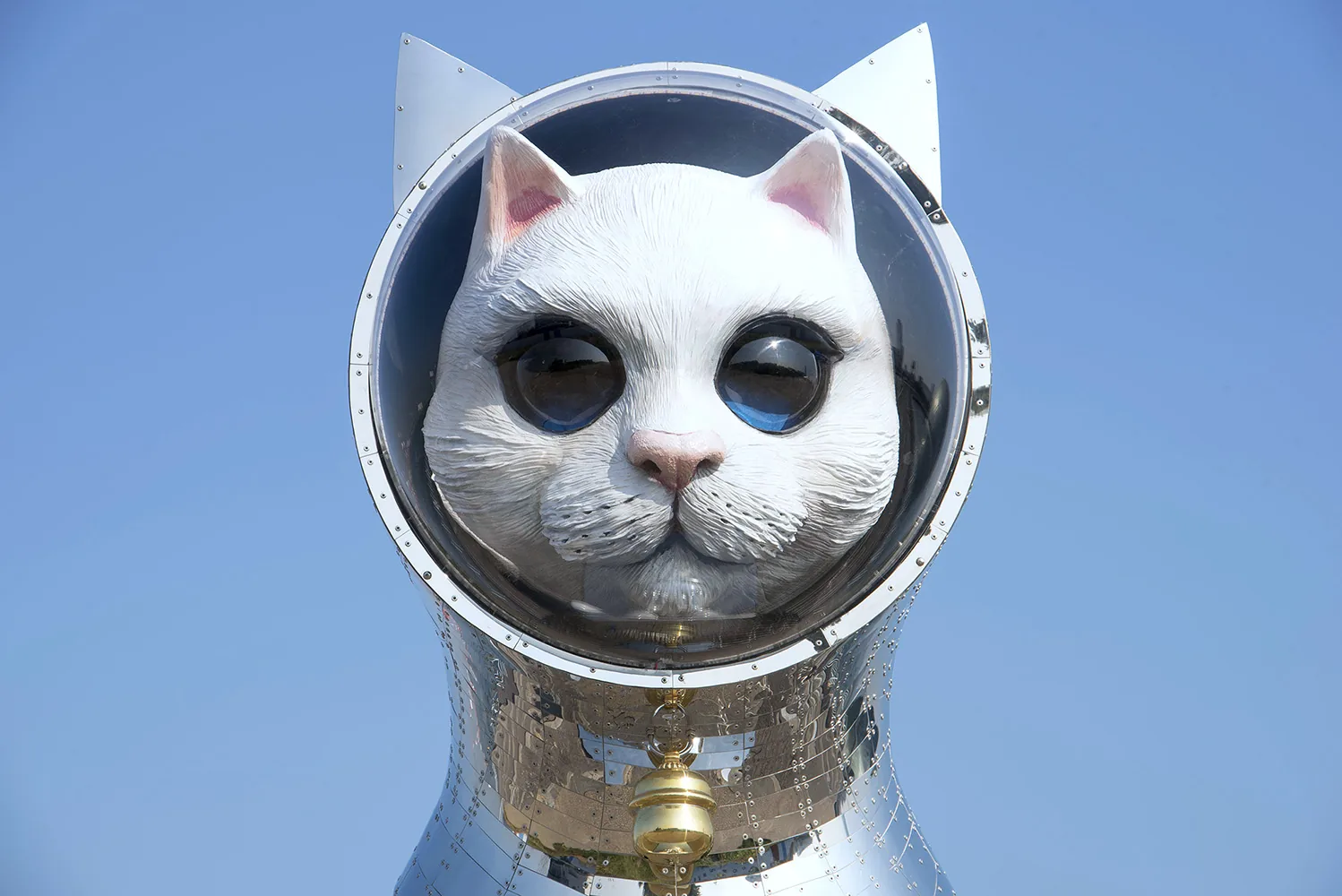
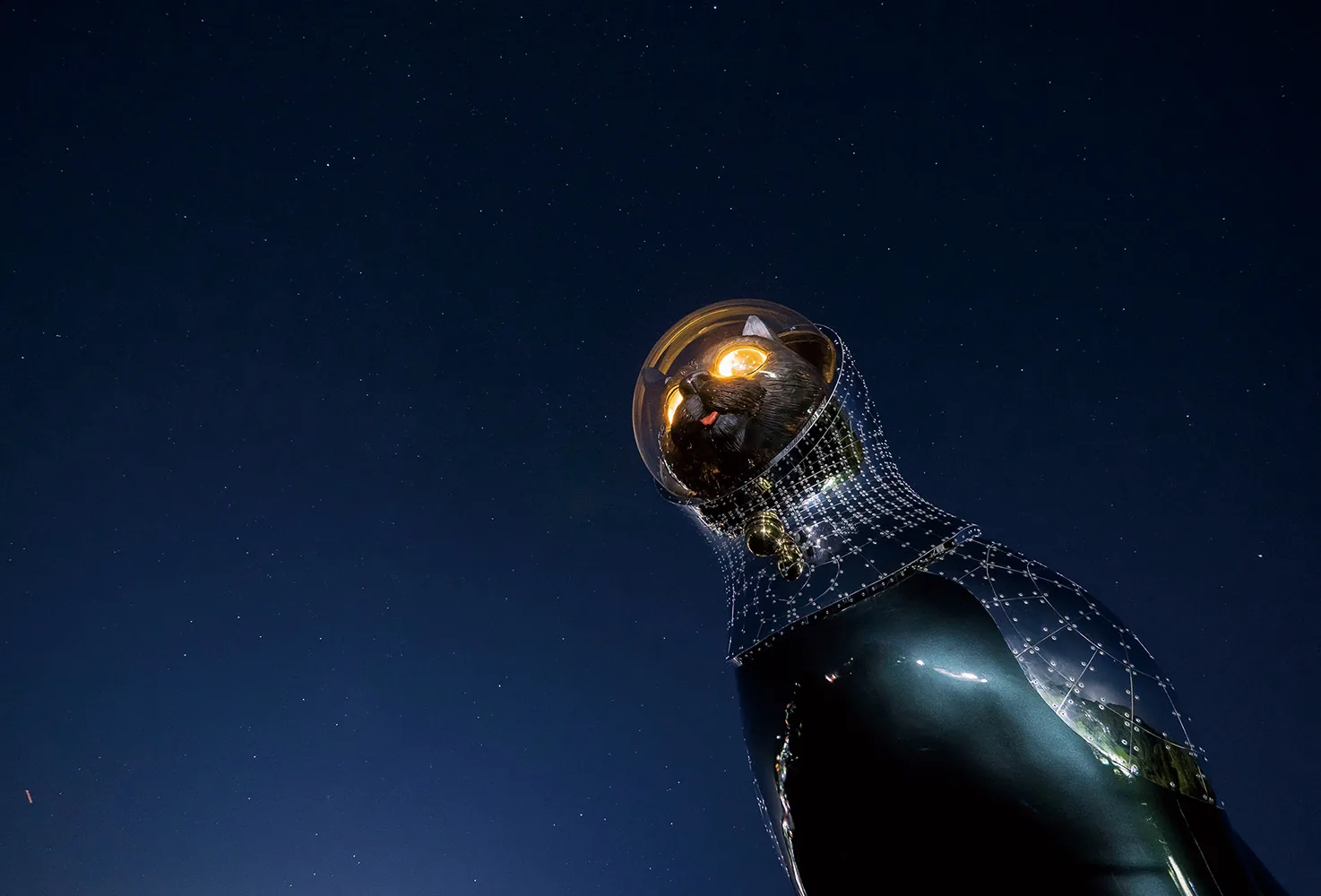
HAKATA · KAMAKURA · KYOTO · TAKAMATSU · HIROSHIMA
In Hakata it watches over a hostel; in Kamakura and Kyoto it takes on different forms. The same “traveling guardian” changes in relation to each building and city it encounters.
21 / 36The Journey of the Works
BIG CAT BANG · 2024
Work / Year CreatedBIG CAT BANG · 2024
LocationChuo Ward, Tokyo / GINZA SIX Central Atrium (Exhibition Ended)
StoryThe central atrium of GINZA SIX became an exhibition space where the story could be seen across floors. The exhibition ended in September 2025.
Artistic IntentThe spacecraft LUCA and space cats spread a new myth about the origin of life through the space.
Source Material ↗
22 / 36The Journey of the Works
H 6.6 × W 6.3 × D 8.6 M
Work / Year CreatedBIG CAT BANG · 2024
LocationChuo Ward, Tokyo / GINZA SIX Central Atrium (Exhibition Ended)
StoryAn installation 6.6 meters high, 6.3 meters wide, and 8.6 meters deep appeared in an atrium visible from several floors.
Artistic IntentThe story of the space cats became an encounter on the scale of the architecture itself.
Source Material ↗
23 / 36The Journey of the Works
SHIP’S CAT ISLAND · HANNO · 2025
Work / Year CreatedSHIP’S CAT ISLAND · 2025
LocationHanno, Saitama / Metsa, Lake Miyazawa
StoryInstalled on the surface of Lake Miyazawa for the opening exhibition of Hyper Museum Hanno.
Artistic IntentThe story of an island where the space cats of BIG CAT BANG rest became a monumental work floating on the water.
Source Material ↗
24 / 36The Journey of the Works
LUCA : THE LANDING · OSAKA · 2025
Work / Year CreatedLUCA: THE LANDING · 2025
LocationKitakagaya, Suminoe Ward, Osaka / MASK
StoryThe LUCA spacecraft, first presented at GINZA SIX, was moved into a former factory exhibition space.
Artistic IntentThe spacecraft “landed” again, exhibited in the same space as works held by MASK.
Source Material ↗
25 / 36The Journey of the Works
JOURNEY OF LIFE · OSAKA AIRPORT STATION · 2024
Work / Year CreatedJourney of Life · 2024
LocationToyonaka, Osaka / Outside the Ticket Gates of Osaka Airport Station, Osaka Monorail
StoryInstalled at the station through a project by the Japan Traffic Culture Association and Osaka Monorail, becoming a work commuters encounter every day.
Artistic IntentYanobe created the original design and supervised its realization as a 12.38-meter-long stained-glass work about the journey of life.
Source Material ↗26 / 36How the Work Was Made
MIYAZAWA LAKE · HANNO
The starting point was Lake Miyazawa in Hanno, Saitama. Looking at the lake, Yanobe imagined a giant cat sleeping there. The real landscape became the first material for the story.

27 / 36How the Work Was Made
Concept Image · 2024
A concept drawing for imagining the interior before completion. Created in part with generative AI, this image is not a photograph of the finished work. It is a blueprint of the imagination before it meets a real place.

28 / 36How the Work Was Made
SHIP’S CAT ISLAND · Production, 2025
The work takes shape by human hands. Inside the red island, Yanobe paints the murals himself. The maker’s time and physical presence remain on the surface of this imagined world.
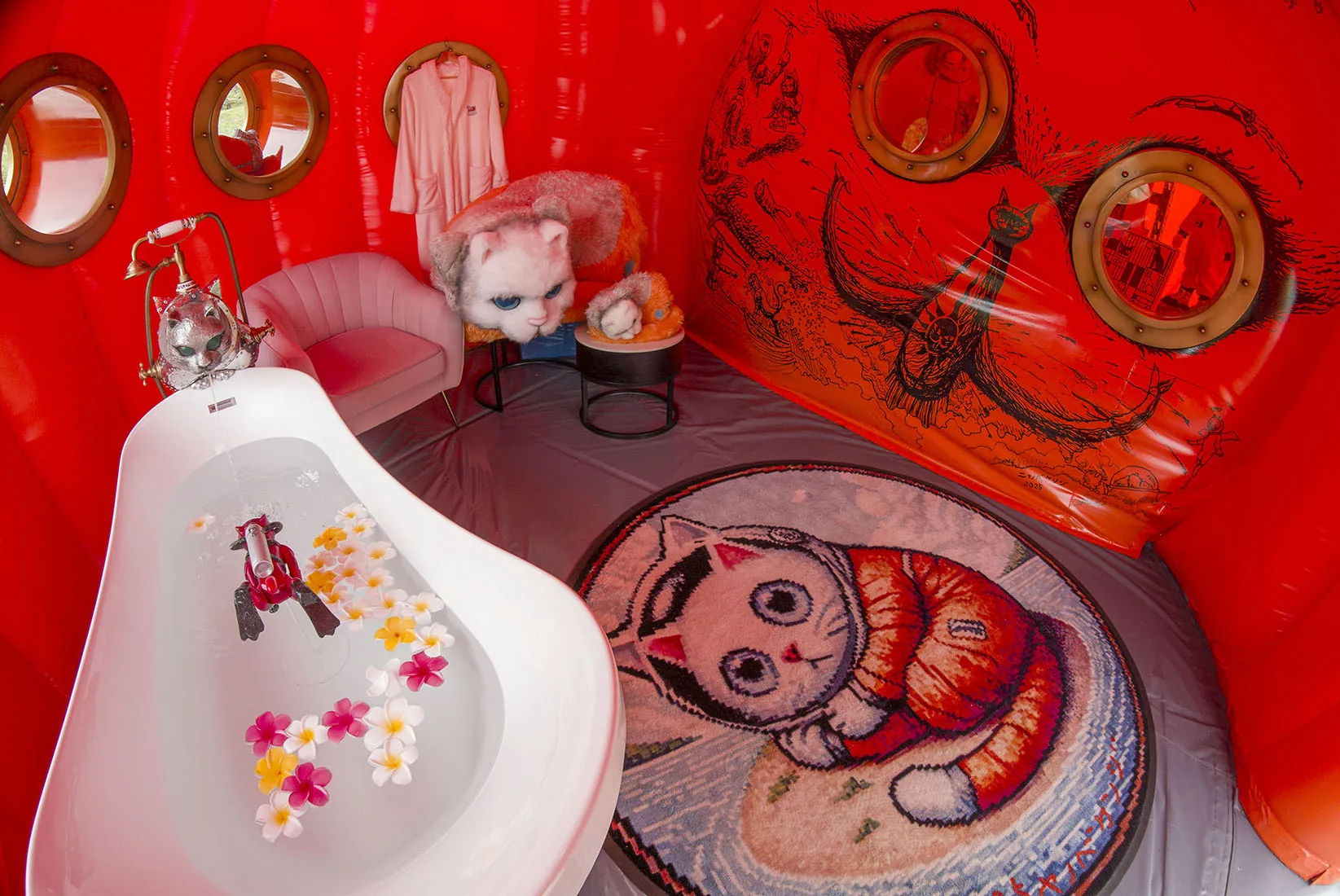
29 / 36How the Work Was Made
SHIP’S CAT ISLAND · Opening Exhibition, 2025
The work did not end with its completion. During the exhibition, visitors approached by boat and entered the island. Viewers of the story moved inside it.
30 / 36What the Works Leave Behind
After exhibitions, works enter museum collections and remain part of the cityscape. From here, awards, exhibitions, collections, and public-space projects are traced in Japan and internationally.
Activity in Japan
From the former Expo ’70 site in Osaka to museums, station plazas, and urban atriums: exhibitions built up in Japan and works that remain where people can encounter them.
Selected Records in Japan
Approximately 40 major and new works were exhibited.
A solo exhibition at the museum.
A boat-shaped work that appeared in the city and on the waterfront for Aqua Metropolis Osaka.
A figure of hope stands outside a station in the artist’s hometown of Ibaraki.
A kinetic sculpture created with Beat Takeshi, installed at Miido Shrine.
A public artwork standing in front of the museum in Kobe.
An award for the facility’s façade incorporating SHIP’S CAT, rather than an award to the artist himself.
Created in 2021. It welcomes visitors to the museum, which opened the following year.
A solo exhibition at the Taro Okamoto Memorial Museum in Tokyo.
An exhibition in the central atrium. It ended in 2025.
31 / 36Creating Together
Works Born from Seven Collaborations
Encounters with different places and techniques—a lake, hostels, museums, a station, and materials—gave the works new forms and new points of contact with people.

32 / 36Creating Together
ONIKURU, IBARAKI × YANOBE KENJI
Work / Year CreatedSHIP’S CAT (ONK-1 / ONK-2) · 2023
LocationIbaraki, Osaka / Related Project at Onikuru
StorySHIP’S CAT took on a form that people could encounter at a multipurpose facility in Ibaraki.
Artistic IntentThe cat character grew into a story for people visiting the multipurpose facility.
Source Material ↗

33 / 36Creating Together
Osaka Monorail / Japan Traffic Culture Association
Work / Year CreatedJourney of Life / Journey of Life Train · 2024 and 2025
LocationOsaka Airport Station / Osaka Monorail Train
StoryThe imagery from the station’s stained glass became the original art for a wrapped train the following year.
Artistic IntentA single story of life took form as light fixed in a station and a train moving through the city.
Source Material ↗Selected Collaborations / Where Works Meet
With each encounter across disciplines, technologies, and places, the world of the works has taken on a new form.
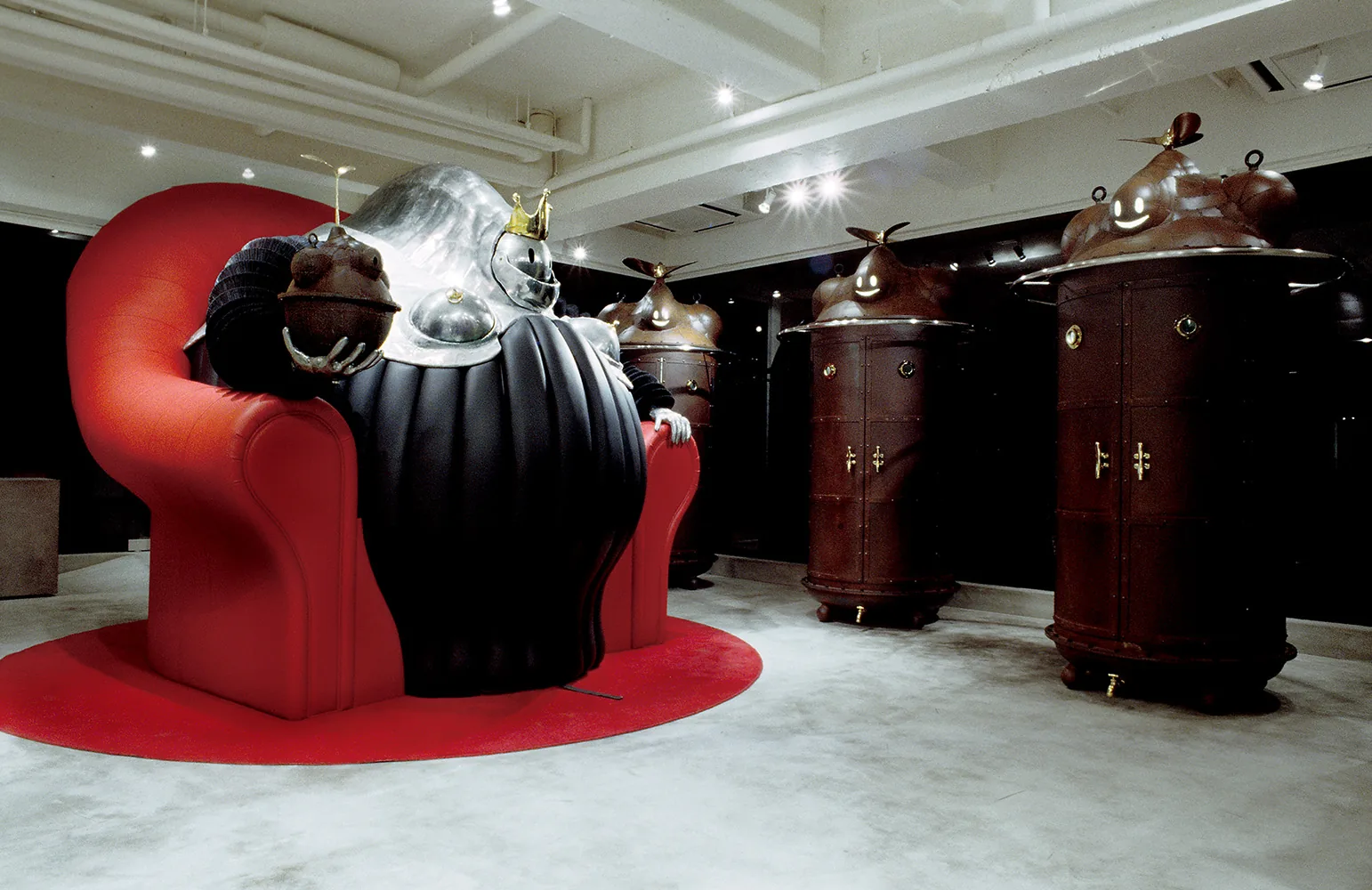
ISSEY MIYAKE × YANOBE KENJI
Queen Mamma
LocationTokyo / ISSEY MIYAKE FÊTE · MDS | G
Created a sculpture that could serve as a changing room for a new store. Changing clothes became an experience of being reborn in a womb-like space.
Work Details ↗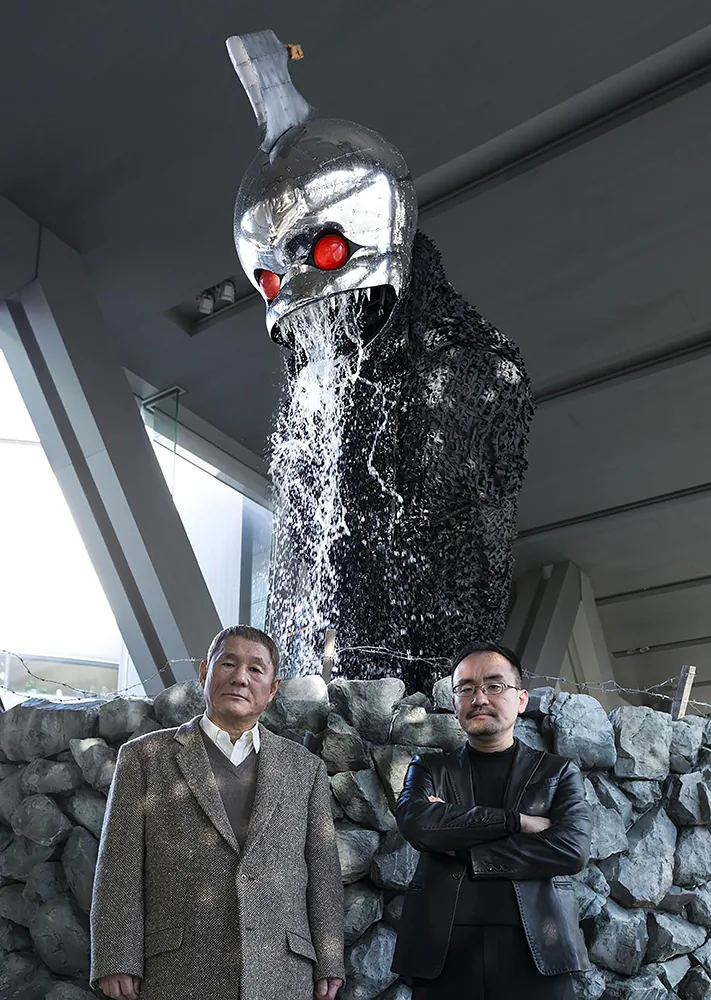
Beat Takeshi × YANOBE KENJI
ANGER from the Bottom
LocationShodoshima, Kagawa / Miido Shrine
A kinetic sculpture created together, in which a monster rises from an old well and spouts water. Installed at Miido Shrine on Shodoshima.
Work Details ↗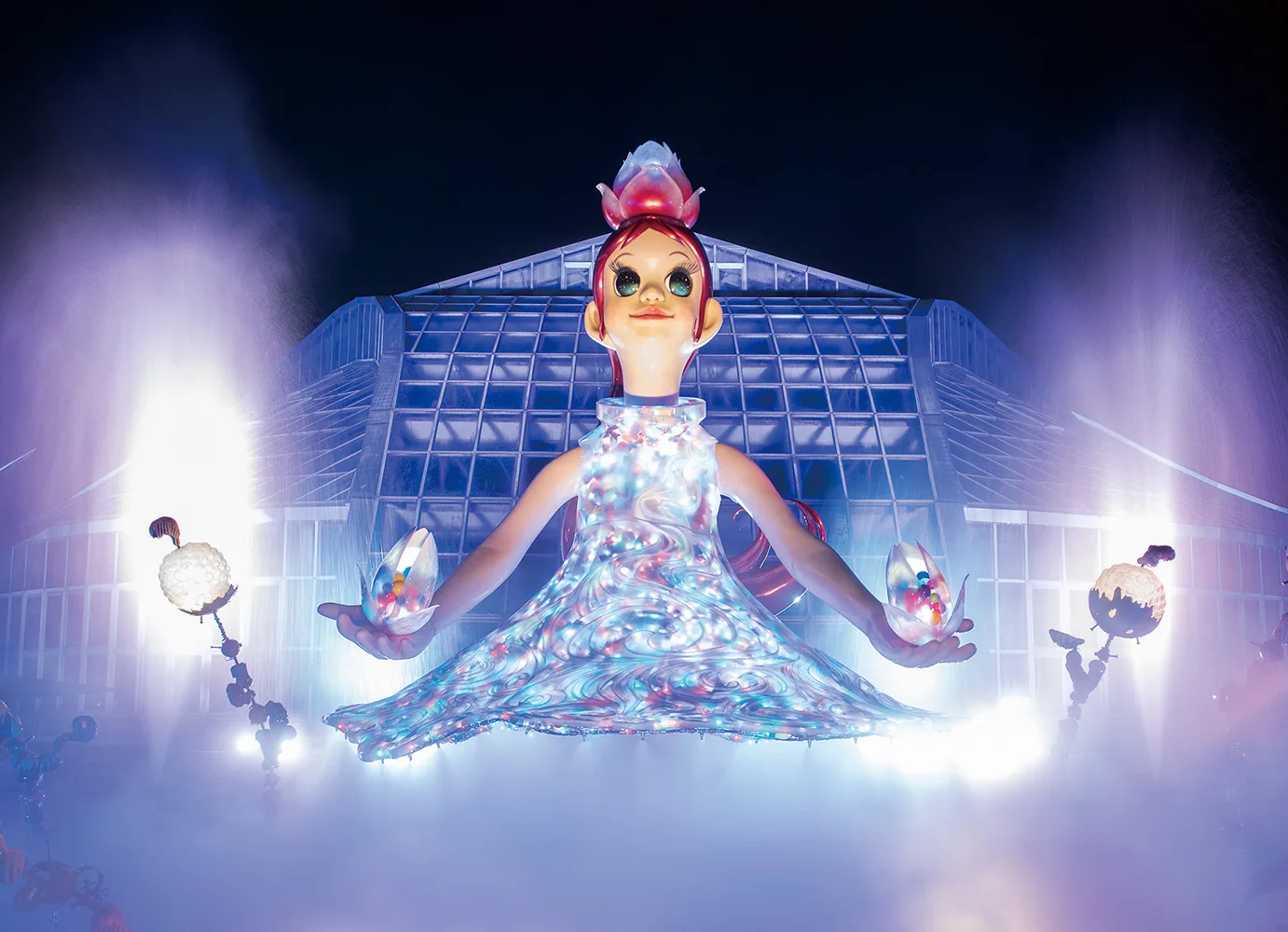
Sebastian Masuda × YANOBE KENJI
Flora
LocationKyoto / First Presented at Kyoto Botanical Gardens
First presented at Kyoto Botanical Gardens. Inspired by the goddess of flowers and the name of the botanical garden, Masuda designed clothing and floral ornamentation for Yanobe’s girl figure in this collaborative work.
Work Details ↗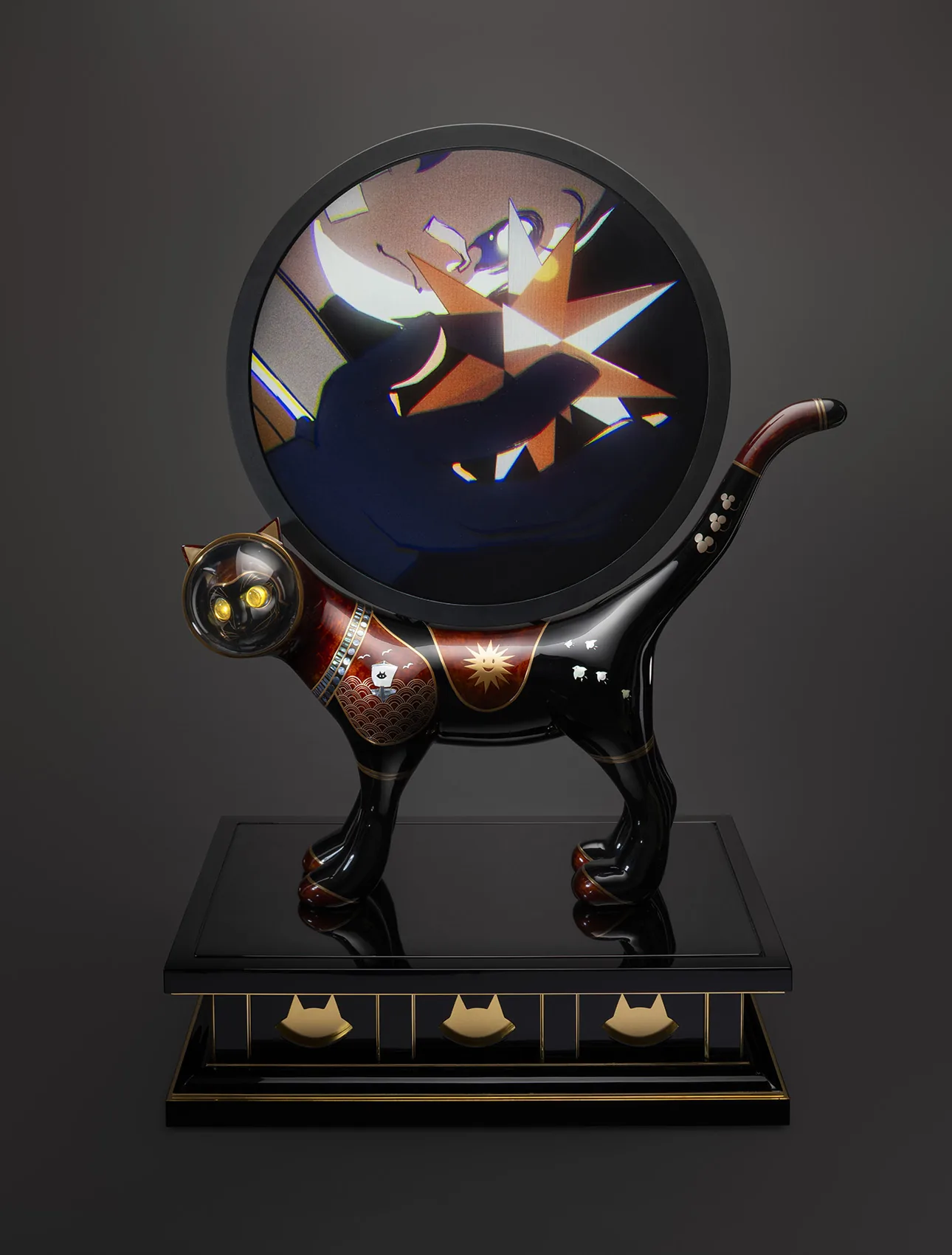
Mai Yoneyama × YANOBE KENJI
SHIP’S CAT (Sun Carrier)
A collaborative work incorporating an animation of the sun by Yoneyama into the back of Yanobe’s jet-black cat sculpture.
Work Details ↗
Takara Standard × YANOBE KENJI
SHIP’S CAT Mirror
A mirror based on SHIP’S CAT was developed jointly as a product using an enamel art panel, bringing the world of the works into everyday spaces.
Work Details ↗34 / 36The Next World of the Works
Five Ways the Works Have Taken Shape.
Monuments, guardians, a cosmic story, an island people can enter, and an image that travels. The world of the works already lives through changing scales, places, and ways of experiencing it.


35 / 36The Next World of the Works
SHIP’S CAT MISTY · KAMEOKA · 2026
Work / Year CreatedSHIP’S CAT MISTY · 2026
LocationKameoka, Kyoto / South Exit of JR Kameoka Station
StoryNamed for the morning mist over the Kameoka Basin, the work was installed at the south exit of JR Kameoka Station.
Artistic IntentIts mirrored body reflects the surrounding landscape and people. It stands as a guide connecting people and nature, past and future.
Source Material ↗